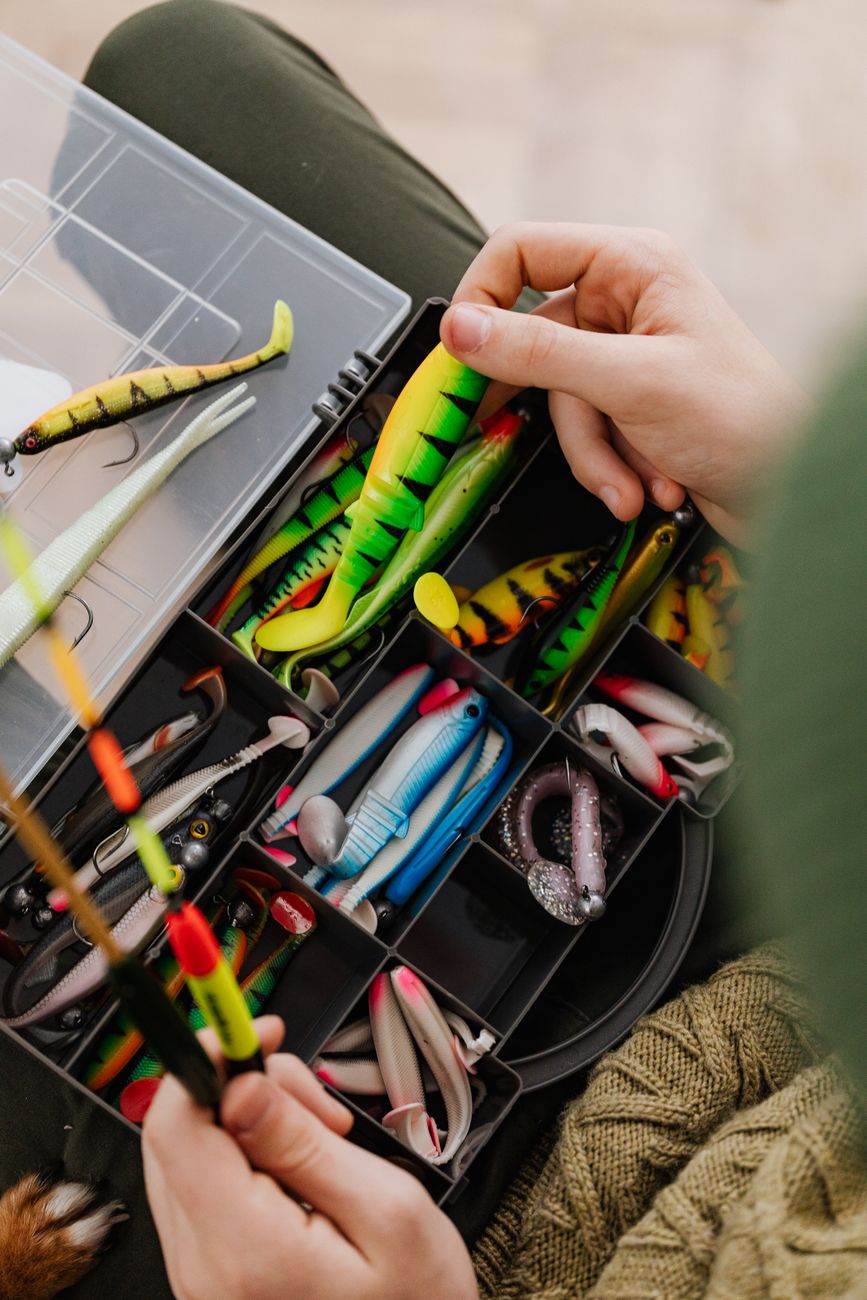
If you have never been fishing before, walking into the fishing section of a sporting goods store can be overwhelming. I did it yesterday and was totally overwhelmed by everything.
There are hundreds of rods, reels, fishing lines, hooks, sinkers, lures, swivels, leaders, floats, tools, tackle boxes, and accessories. Some anglers seem to carry enough equipment to open their own tackle shop (guilty).
The good news is that you don’t need most of it. In fact, you don’t need a fraction of all of it.
Fishing in South Florida can actually be surprisingly simple. You can catch fish from beaches, piers, seawalls, canals, bridges, lakes, and docks with a relatively inexpensive spinning rod and a handful of basic tackle.
You also don’t need to know exactly what species you’re going to catch.
One of the great things about fishing in South Florida is that you never really know what is going to eat your bait. Drop a shrimp near a seawall and you might catch a snapper, jack, grunt, sheepshead, or something completely unexpected like a grouper or moray eel. Yes, I have caught moray eels off sea walls before.
The goal of this guide is therefore not to build the perfect fishing setup for one particular species. Instead, I’m going to cover the basic fishing gear I would recommend to someone who simply wants to start fishing in South Florida.
You can always buy more specialized equipment later.
1. Start With a Spinning Rod and Reel
Your rod and reel will obviously be the most important part of your fishing setup.
For someone who has never fished before, I would recommend starting with a spinning rod and spinning reel.

Spinning reels are relatively easy to learn, versatile, and capable of catching an enormous range of fish.
You don’t need a baitcaster.
You don’t need a conventional reel.
And you definitely don’t need several different rods when you’re just getting started.
A medium or medium-heavy spinning rod somewhere around 6.5 to 7 feet long is a great general-purpose starting point.
Pair that with approximately a 3000- or 4000-size spinning reel, and you have a setup that can handle a surprisingly large percentage of the fishing you might encounter around South Florida. If you are having a hard time with what those values mean, just think of them as a reel that can catch bass as well as a snook. Any bigger fish may need heavier gear.
With a setup like this, you could potentially fish:
- Residential canals
- Seawalls
- Piers
- Docks
- Bridges
- Beaches
- Mangrove shorelines
- Freshwater lakes and canals
It isn’t going to be perfect for everything.
You wouldn’t want to use the same setup for offshore trolling or targeting giant sharks from the beach. But that’s not what we’re trying to accomplish. If you are trying to accomplish this, then we will have to talk later when I write a post on that.
We’re looking for something versatile enough that a beginner can grab one fishing rod and go fishing.
Should You Buy a Rod and Reel Combo?
For your first fishing setup, a rod and reel combo can make a lot of sense and therefore, I say, go for it.
The manufacturer or retailer has already paired a reasonably appropriate reel with the rod, which eliminates another decision you have to make.
You can certainly purchase the rod and reel separately, but don’t feel like you need to.
Your first fishing rod doesn’t need to be expensive either.
As you fish more frequently, you’ll start figuring out what characteristics you actually care about. You may eventually want a lighter rod for artificial lures, a heavier setup for bridges, or specialized equipment for tarpon.
You’ll make much better purchasing decisions after you’ve spent some time fishing.
My first few rods were rod and reel combos from Walmart. $30 dollars later, I was catching snook out of my boat.
2. Fishing Line

The next thing you’ll need is fishing line.
This is another category that gets complicated very quickly.
You’ll encounter monofilament, fluorocarbon, braid, different colors, different diameters, and dozens of breaking strengths.
For a general South Florida spinning setup, I like braided fishing line for a couple of reasons.
Something around 15 to 20 pound braid gives a beginner a versatile starting point.
Braid has several advantages.
It is relatively thin for its strength, casts well, has very little stretch, and allows you to feel bites and changes in the bottom fairly easily.
That lack of stretch can be particularly helpful when you’re trying to learn what a bite actually feels like.
Braid also lasts quite a while if maintained properly.
It is also fairly thin so you can put a ton of it on your reel. Just be mindful that braid can be a bit expensive.
However, braid does have one important disadvantage.
I generally wouldn’t tie the braid directly to the hook or lure when fishing around many South Florida species.
That’s where leader material comes in.
3. Buy Some Leader Material
A leader is a short section of line between your main fishing line and your hook or lure.
For general South Florida fishing, keeping a spool of fluorocarbon or monofilament leader in your tackle box is extremely useful.
A beginner might start somewhere around the 20 to 30pound range, depending on what they’re fishing for and where they’re fishing. My go to is usually 20 pound mono just because it’s thinner and I don’t necessarily target fish that need heavier line.
The leader serves several purposes.
First, it can be less visible underwater than braided line.
Second, it gives you additional abrasion resistance.
That’s important in South Florida because fish have an incredible ability to find the nearest dock piling, rock, mangrove root, bridge structure, or other sharp object immediately after being hooked, especially if you hook a snook.
Some species also have rough mouths or sharp gill plates that can damage lighter line. There are also quite a few toothy critters in south Florida that can bite through your line.
Don’t become obsessed with finding the perfect leader strength when you’re just starting.
There will always be situations where a lighter or heavier leader is better.
For now, you simply want something versatile.
4. You Only Need a Few Hooks
Walk down the hook aisle and you’ll see dozens of styles.
- Circle hooks.
- J-hooks.
- Octopus hooks.
- Baitholder hooks.
- Wide-gap hooks.
- Treble hooks.
- And seemingly endless sizes.
You don’t need all of them.
If you’re primarily starting with live or dead bait, buy a couple sizes of hooks appropriate for the bait you’re using.
For shrimp and other relatively small baits, you don’t need an enormous hook.
Circle hooks are particularly useful for many types of bait fishing because they are designed to catch near the corner of the fish’s mouth when used properly. Also, circle hooks practically hook the fish themselves so you don’t have to “set the hook”.
The exact hook you need will depend on the species, bait, and fishing regulations, so always check the rules for the type of fishing you’re doing.
But the important lesson for beginners is simple:
You don’t need 15 packages of hooks to start fishing. Just get a pack of small circle hooks and you’re good to go.
Buy a couple of useful sizes and expand your collection as you learn.

5. Get a Small Selection of Sinkers
Sinkers are simply weights that help get your bait deeper into the water or keep it near the bottom.
Again, there are dozens of types.
Egg sinkers, bank sinkers, split shot, bullet weights, and many others.

For basic fishing around canals, docks, seawalls, and similar areas, you can start with a few relatively small weights. I like using egg sinkers.
How much weight you need depends heavily on current.
In calm water, you might need very little weight or none at all.
Around an inlet or bridge with strong tidal current, considerably more weight may be necessary to keep your bait where you want it.
This is something you learn quickly while fishing.
If your bait is immediately swept away from where you’re trying to fish, you probably need additional weight.
If a giant sinker is sitting on the bottom when there is barely any current, you may be using more weight than necessary.
Buy a few sizes rather than trying to predict every possible fishing situation. There are packs of various size sinkers that you can get for relatively cheap.
6. Swivels Are Useful, But Keep It Simple
A swivel is a small piece of terminal tackle that connects different sections of your fishing rig.
They’re inexpensive and useful to have.
For example, you can tie your main line to a swivel and then attach your leader to the other side.
Swivels can also help reduce line twist in certain fishing situations.
However, you don’t necessarily need to put a swivel on every rig.
You can tie braid directly to fluorocarbon using knots such as the double uni knot or other line-to-line connections.
If you’re completely new to fishing, though, using a swivel can make assembling some rigs easier.
Throw a small package in your tackle box.
7. Pliers Might Be the Most Important Tool You Buy
If there’s one piece of fishing equipment beginners frequently overlook, it’s a good pair of fishing pliers. I cannot stress this enough.
You’ll use them constantly.
Pliers can help you remove hooks, cut line, crimp tackle, and deal with hooks that you don’t necessarily want your fingers anywhere near.
South Florida also has plenty of fish with sharp teeth, spines, or powerful jaws. Examples are snapper, sharks, catfish, and stingrays. Also, there are some fish like stonefish and lionfish that you do not want to handle at all.
You should not automatically grab every fish you catch with your bare hands.
A decent pair of corrosion resistant fishing pliers is inexpensive and deserves a permanent place in your tackle box. You don’t even need to get them from a tackle store. Any hardware store will have a good set of pliers.
If you’re fishing in saltwater, rinse them with fresh water after your trip.
Actually, that’s good advice for almost everything you bring saltwater fishing. Corrosion can destroy every piece of equipment you have.
8. Get a Small Tackle Box
You do not need a giant tackle box.
In fact, I think carrying too much equipment can make fishing less enjoyable when you’re starting.
A small plastic tackle tray is enough to organize:
- Hooks
- Sinkers
- Swivels
- A few lures
- Spare tackle
Put the tray inside a small backpack along with your leader, pliers, water, sunscreen, and other essentials. I bought a cheap backpack online and just carry everything in there.
That’s enough for many shore based fishing trips.
One of the biggest advantages of fishing from shore is mobility.
If there aren’t fish where you’re standing, you want to be able to move.
Dragging 40 pounds of fishing equipment around makes that much less appealing.
9. Start With Shrimp
If you’re wondering what bait to buy for your first South Florida fishing trip, shrimp is difficult to beat. Live or dead shrimp.

A huge variety of saltwater fish will eat shrimp.
Depending on where you’re fishing, shrimp can attract snapper, snook, jacks, sheepshead, grunts, pinfish, and many other species.
Live shrimp are excellent, but dead shrimp can catch plenty of fish too.
Shrimp are also easy for beginners to understand.
You don’t have to learn how to work an artificial lure properly.
You put the bait on the hook, get it into an area where fish are feeding, and wait for something to eat it.
That’s a pretty good way to learn.
As you become more experienced, you can experiment with pilchards, mullet, crabs, squid, cut bait, and other natural baits.
But if I were taking someone saltwater fishing for the first time and simply wanted them to catch something, shrimp would be high on my list, probably number 1.
10. Buy a Few Artificial Lures — Not 50
Artificial lures are where tackle boxes can get out of control.
Fishing stores are filled with lures in every imaginable shape, color, and size, and they all work. Really…they all work.
You do not need all of them.
If you want to try artificial lures, start with a few versatile options.
A soft plastic paddle tail is one of my favorites because it can imitate a small baitfish and catch numerous species.
A small jig is another extremely versatile option. You can’t go wrong with a bucktail jig.
A topwater lure can be fun, particularly early in the morning when fish are actively feeding near the surface.
You could easily start with only three categories:
- Soft-plastic paddle tail
- Jig
- Small topwater lure
Learn how to use those before buying another 30 lures.
You’ll eventually discover what works best where you fish.
11. Learn One or Two Basic Fishing Rigs
Fishing rigs can look incredibly complicated when you’re new.
Don’t worry about learning all of them.
You can catch plenty of fish with just a couple basic setups.
Honestly, just look up fishing rigs on YouTube and there will be a million different setups. It’s super easy to learn.
Free-Lined Shrimp
This may be about as simple as fishing gets.
Tie your leader to your main line, attach a hook, put on a shrimp, and cast it out.
No weight.
The shrimp is allowed to move relatively naturally through the water.
This works particularly well when current and depth allow you to keep the bait where the fish are without additional weight.
I use this method in the Florida Keys to catch just about everything.
Basic Weighted Rig
If you need to get your bait toward the bottom, add a sinker.
A simple weighted rig can be used around docks, bridges, seawalls, canals, and many other areas.
The goal isn’t to create something complicated.
You’re simply using enough weight to put the bait where fish are feeding.
put a weight about the swivel that connects the leader to the main line. Super easy and I use this about 80% of the time.
Popping Cork
A popping cork can also be useful, particularly when fishing shrimp.
The cork helps suspend your bait at a particular depth, and popping the cork creates noise that can attract attention.
These few options can cover a surprising amount of fishing.
12. Bring Something to Measure Your Fish

If you plan to keep fish, you need to know whether they’re legal.
Florida fishing regulations can include minimum sizes, maximum sizes, slot limits, bag limits, closed seasons, and other restrictions.
Never assume a fish is legal because it “looks big enough.”
Keep a measuring tape or fishing ruler with your equipment.
They’re inexpensive and take up almost no room.
You should also know how the particular species is legally measured before keeping it.
Make sure to download the FWC app on your phone to look up the legal sizes since they change almost daily.
13. Bring a Dehooking Tool
A dehooker isn’t absolutely necessary, but I think it’s worth having.
It allows you to remove hooks while minimizing the amount of handling required, which can be especially useful when you’re releasing fish.
It also gives you more distance between your hand and the fish.
That’s a nice feature when the fish has teeth, spines, or simply refuses to stop moving.
It is also good to have if you are catching smaller fish because it will be less aggressive at taking out the hook from the smaller fish compared to pliers doing it.
14. Don’t Forget Sun Protection
This isn’t fishing tackle, but in South Florida it absolutely belongs on your fishing gear list.
The sun can be brutal. The sun IS brutal!
Bring sunscreen.
A hat and polarized sunglasses are also extremely useful.
Polarized sunglasses have the added benefit of reducing glare from the surface of the water, which can make it much easier to see fish, structure, grass, rocks, and other underwater features.
If you become serious about fishing, you’ll quickly understand why so many anglers wear long-sleeved sun shirts, hats, and neck protection.
Also, if the fishing is hot, you’ll probably be in the sun longer. You don’t want to get a nasty sunburn.
15. Bring Water
This sounds obvious until you’re standing on a seawall in South Florida in August.
Bring more water than you think you’ll need.
Heat and humidity can become dangerous, particularly if you’re fishing for several hours without much shade.
Fishing is supposed to be enjoyable.
Being dehydrated isn’t.
16. What You Don’t Need
This might be the most important section of this entire guide.
You don’t need expensive fishing equipment to start catching fish.
You probably don’t need:
- A $500 fishing rod
- A $500 reel
- A giant tackle bag
- 50 artificial lures
- Five different fishing rods
- Specialized offshore equipment
- A fish finder
- A boat
- The newest fishing gadget you saw online
- Literally anything that is being shoved down your throat on social media.
None of these things are inherently bad.
If you become obsessed with fishing, you’ll probably accumulate an impressive amount of equipment over time.
But buying more gear doesn’t automatically mean you’ll catch more fish.
For beginners, learning where fish live, when they’re feeding, how tides affect them, how to present bait, and how to recognize bites is far more important.
17. A Simple South Florida Beginner Fishing Kit
If a friend told me tomorrow that they had never fished before and wanted to start fishing in South Florida, I would keep their first setup extremely simple.
I’d suggest something along these lines:
- Approximately 6.5 to 7 foot medium or medium-heavy spinning rod
- 3000- or 4000-size spinning reel
- 15- to 20-pound braided line
- 20- to 30-pound leader material
- A few appropriately sized hooks
- Several small sinkers
- Small package of swivels
- Fishing pliers
- Small tackle tray
- Measuring tape
- Dehooking tool
- A few soft-plastic lures
- Shrimp
- Sunscreen
- Polarized sunglasses
- Water
That’s it.
You could fit almost everything other than the rod into a backpack.
More importantly, that setup gives you the ability to actually go fishing rather than spending weeks researching equipment.
18. Where Should You Use Your New Fishing Gear?
Once you have your basic equipment, you need somewhere to use it.
Fortunately, South Florida has an enormous amount of accessible water. You can’t walk more than 100ft without hitting a body of water down here.
Depending on where you live, you may have access to:
- Public fishing piers
- Beaches
- Canals
- Lakes
- Seawalls
- Bridges
- Parks
- Jetties
- Freshwater canal systems
Don’t assume you need a boat.
South Florida offers excellent shore based fishing opportunities. and most of the time, the people in boats are fishing right where you can fish from shore. And they are paying for gas.
Pick an accessible location, bring one rod and a small amount of tackle, and start experimenting.
19. Saltwater or Freshwater?

South Florida is unusual because beginners have excellent freshwater and saltwater fishing opportunities.
Saltwater fishing might put you around snapper, jacks, snook, barracuda, tarpon, mackerell, and numerous other species.
Freshwater canals and lakes can contain largemouth bass, peacock bass, various cichlids, and other fish.
You don’t necessarily need completely different equipment to try both.
Your basic spinning setup can work in either environment.
You’ll change your bait, lures, leader, and techniques depending on what you’re targeting, but the fundamental equipment can remain surprisingly similar.
Just remember to thoroughly rinse your rod and reel with fresh water after using them in saltwater.
Salt is extremely hard on fishing equipment.
20. Your First Fishing Trip Doesn’t Need to Be Complicated
Here’s what I’d do if I had never fished before and wanted to try fishing in South Florida this weekend.
I’d get a basic spinning combo.
I’d spool it with line and learn one reliable knot.
I’d buy a small package of hooks, a couple sinkers, some leader material, and a pair of pliers.
Then I’d pick up some shrimp. If live shrimp, you’ll need a bucket and aerator. If dead, just place it in a container with an icepack.
I’d find a legal and accessible place where people regularly fish , perhaps a pier, seawall, canal, or bridge, and spend a couple hours there.
That’s it.
Your goal on your first trip shouldn’t be catching a trophy snook or tarpon.
Your goal should be learning.
Practice casting.
Learn how to keep your line tight.
Figure out what your bait feels like underwater.
Learn the difference between your sinker hitting the bottom and a fish biting.
Catch some small fish.
Learn how to safely remove a hook.
And most importantly, pay attention to what is happening around you.
If there are a ton of people fishing around you, watch what they do. Pick up on the different methods of fishing and techniques.
Fishing gets much easier once you start understanding the water.
Start Simple and Add Gear as You Need It
Fishing equipment can become as complicated as you want to make it.
There are specialized rods for particular techniques, reels designed for specific environments, countless fishing lines, thousands of lures, and seemingly endless accessories.
You may eventually want some of them.
But you don’t need them to start fishing.
A basic spinning rod and reel, fishing line, leader, hooks, a few sinkers, pliers, and some bait can put you in a position to catch fish throughout South Florida.
After you’ve gone fishing several times, you’ll begin identifying actual problems that new equipment can solve.
- Maybe you need a heavier rod because you’re fishing around bridges.
- Maybe you want a lighter setup for peacock bass.
- Maybe you discover that you love throwing artificial lures from the beach.
- Maybe you become interested in targeting tarpon.
That’s when buying specialized equipment starts making sense.
Don’t build your tackle collection around the fisherman you think you’re going to become.
Build it around the fishing you’re actually doing.
For your first trip, keep it simple, grab one rod, a small tackle box, and some bait, and go see what bites.
That’s really all you need to start fishing in South Florida.


Leave a Reply