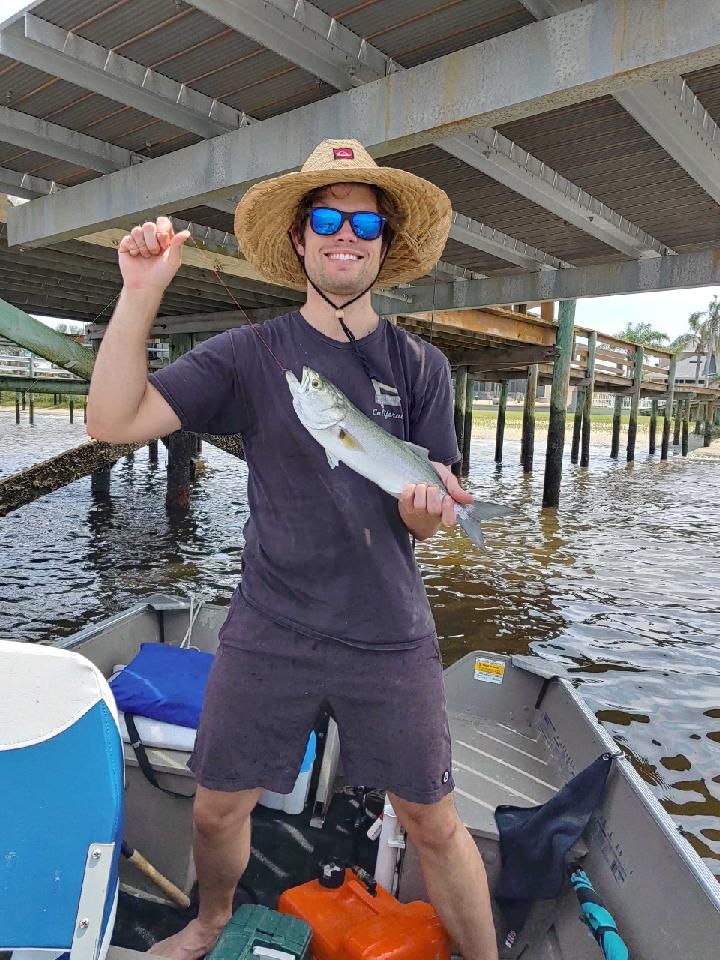
You do not need a boat to catch fish in South Florida. Yes, it is true!
In fact, some of the most productive fishing spots in Miami, Fort Lauderdale, the Florida Keys, and the rest of South Florida can be reached without ever stepping onto a boat. Docks, piers, seawalls, bridges, and marina structures create exactly the type of habitat that many South Florida fish like to use.
For someone who is new to fishing, dock fishing is also one of the easiest ways to get started.
You can bring a relatively inexpensive rod, a small tackle box, a bucket of shrimp, and be fishing within minutes. There is no boat to launch, no complicated electronics to learn, and no need to make long casts, no need to fill up a boat with gas!!!!!
Dock fishing is especially good for families. Kids can fish directly below their feet, which means they do not necessarily need to learn how to cast before they can start catching fish.
But there is a big difference between fishing from a random dock and fishing from a good fishing dock.
In this guide, I will cover what makes a good fishing dock, the tackle you need, the best bait to bring, when to fish, how to fish with kids, what species you might catch, and some public fishing docks and piers around Miami.
If you are looking for one of the easiest ways to start fishing in South Florida, this is it.
Why Are Docks So Good for Fishing?

The first thing to understand is that the dock itself is fish habitat.
A dock might look like nothing more than wood or concrete sticking into the water, but underwater it can become a miniature reef.
Pilings collect barnacles, algae, oysters, sponges, and other marine growth. Small shrimp, crabs, and baitfish use the structure for protection. Larger fish eventually show up because there is food available.
This creates a simple food chain:
Structure → marine growth → small bait → larger fish
That is why one of the biggest mistakes people make while dock fishing is casting as far away from the dock as possible.
Sometimes the fish are 50 yards away.
But very often they are five feet away.
Or directly underneath you.
Sheepshead, mangrove snapper, snook, grunts, jacks, pinfish, and many other species regularly hold extremely close to structure.
The dock is not just a convenient place for you to stand.
The dock is often the reason the fish are there.
What Makes a Good Fishing Dock?
Not every dock is worth fishing.
If I were looking at an unfamiliar dock in South Florida, there are several things I would look for before even getting my rod out.
Look for Moving Water
Current is one of the biggest things I look for.
A dock sitting beside completely stagnant water may hold fish, but a dock where tidal water regularly moves past the pilings is usually more interesting.
Current carries shrimp, small baitfish, crabs, plankton, and other food past the dock.
Predatory fish can sit behind pilings and wait for the current to bring food directly to them.
Think of the piling as a rock in a river.
Water hits the piling and moves around it, creating a small area of slower water behind the structure. Fish can sit in that slower water while waiting for prey to pass.
That little current break can be one of the best places to put your bait.
Look for Barnacles and Marine Growth

A clean piling is usually less interesting to me than a piling covered in life.
Look down at the structure.
Do you see
- Oysters?
- Barnacles?
- Algae?
- Small crabs?
- Tiny baitfish?
If the answer is yes, that is a good sign.
Marine growth creates food and attracts small organisms, which attract larger fish.
This is particularly important if you are targeting sheepshead.
Sheepshead spend a lot of time around pilings, bridges, seawalls, and other hard structure where crustaceans are available.
If you see old pilings completely covered with barnacles, I would absolutely make a few drops around them.
Look for Deeper Water
Depth helps.
A dock extending over two feet of featureless water might produce fish at certain times, but a dock reaching into a six, ten, or twenty-foot channel gives fish more options.
This becomes especially important during temperature extremes and different stages of the tide.
A dock that provides access to both shallow and deeper water is even better.
Fish can move between the two without traveling very far.
My favorite dock to fish drops from 3 ft all the way down to 15 ft at the end. I’ve caught flounder, snapper, groupers, sharks, and even eels there.
Look for a Channel

One of my favorite situations is a dock sitting near a channel.
Channels act like underwater highways.
Fish moving through Biscayne Bay and the Intracoastal Waterway frequently use channels, drop-offs, bridges, mangrove shorelines, and other defined structure.
A dock extending toward a channel gives you access to both the structure underneath the dock and fish moving through deeper water.
That gives you multiple ways to fish from the same location.
Look for Lights
Dock lights can completely change a fishing spot after sunset.
Lights attract plankton and small organisms.
Those attract baitfish.
The baitfish attract predators.
If you see a dock light creating a bright patch of water with small fish constantly swimming through it, pay attention to the edge of the light, not just the brightest area.
Predators such as snook can sit in darker water and attack baitfish that move across the boundary.
A dock that looks completely ordinary at 2 p.m. can become an excellent fishing spot after dark.
Just make sure the dock or park is legally open at night.
Look for Bait
This might be the simplest rule in fishing.
Find the food!!!!
Look into the water before you start fishing.
You might see mullet, glass minnows, pilchards, pinfish, shrimp, crabs, or schools of tiny baitfish.
You might also see birds actively feeding.
If bait is constantly moving around the dock, something larger is probably interested in eating it.
A beautiful fishing spot with absolutely no signs of life can sometimes be worse than an ugly seawall where bait is everywhere.
Look for Multiple Types of Structure
The best dock-fishing locations often combine several features.
For example:
Dock + channel + mangroves + current
Or:
Bridge + dock + deep water + lights
Or:
Seawall + rocky bottom + current + baitfish
The more reasons fish have to be somewhere, the more interested I become in fishing it.
South Florida has a huge amount of seawalls, bridges, marinas, mangroves, canals, docks, and artificial structure.
Use that to your advantage.
What Tackle Do You Need for Dock Fishing in South Florida?
You do not need specialized equipment.
If I wanted one simple setup that could catch most of the fish around South Florida docks, I would bring:
Rod: 7-foot medium or medium-heavy spinning rod
Reel: 3000 or 4000-size spinning reel
Main line: 15–20 lb braided line
Leader: 15–30 lb fluorocarbon or monofilament
Hooks: #1 to 2/0 circle hooks
Weights: Small assortment of split shot and 1/4- to 1-ounce sinkers
That setup will handle a huge percentage of the fish you encounter.
You could catch snapper, jacks, sheepshead, small snook, grunts, catfish, and plenty of other species.
If you are specifically targeting larger snook or tarpon around heavy structure, you may want heavier tackle, especially when they try and take you around the pilings.
But you do not need to start there.
Why I Like Braided Line for Dock Fishing
Braided line is useful around docks because it has very little stretch.
That helps you feel bites.
More importantly, it gives you better control when a fish immediately tries to run around a piling. (cough, cough SNOOK!)
That happens a lot.
You hook a good fish.
The fish turns.
Three seconds later your line is wrapped around a barnacle-covered piling.
Game over.
Being able to apply pressure quickly can make the difference.
The downside is that braid has poor abrasion resistance against sharp structure, which is why I normally use a leader.
What Leader Should You Use?
For general dock fishing, I would start around 20 lb leader, preferably mono.
If the water is extremely clear and the fish are being difficult, you can drop to 10–15 lb.
If you are getting broken off around pilings or targeting bigger fish, move to 30–40 lb.
Leader choice is always a compromise.
Lighter leader gets more bites.
Heavier leader survives structure better.
I would rather start somewhere in the middle and adjust based on what happens.
The Simplest Dock Fishing Rig

One of the best things about dock fishing is that your rig does not need to be complicated.
My basic setup would be:
Main line → leader → circle hook
Put a live shrimp on the hook and let it drift naturally around the dock.
That is it.
If the current is too strong or the fish are near the bottom, add a small weight.
Use the lightest weight that allows you to reach the depth you want.
You do not necessarily need a giant sinker sitting on the bottom.
A shrimp slowly drifting past a piling can look much more natural.
What Bait Should You Bring?
If someone told me I could bring only one bait to a South Florida dock, I would bring live shrimp.
Live Shrimp

Shrimp catch almost everything. You can read more about this (here)
That is why they are such a good option for beginners.
You can catch mangrove snapper, sheepshead, snook, grunts, jacks, pinfish, mojarras, catfish (grrrrr), small groupers, and plenty of random species.
And that last part is important when fishing with kids.
Kids usually do not care whether the fish is a trophy.
They want something to pull on the line.
Shrimp give you a very good chance of getting bites from whatever happens to be around the dock.
Frozen Shrimp
Frozen shrimp are another good option.
They are cheaper, easier to transport, and you do not need to keep them alive.
The downside is that small fish can tear frozen shrimp off your hook quickly.
If you are bringing children fishing for an hour or two, though, a bag of frozen shrimp can be one of the easiest options available.
Cut Bait
Cut bait works extremely well when there are snapper and other predatory fish around.
Small pieces of pilchard, squid, mullet, or ballyhoo can all work.
Keep the pieces relatively small when you are targeting snapper around a dock.
A bait does not need to be enormous to catch a decent fish.
Live Pilchards or Small Baitfish
If you know how to catch and keep live bait, your options increase considerably.
Live pilchards can be excellent for snook, snapper, jacks, and tarpon.
A lively baitfish swimming around a piling is difficult for a predator to ignore.
But I would not recommend making live bait complicated if you are just starting.
Buy shrimp.
Go fishing.
Learn the spot.
You can worry about cast nets and live bait systems later.
Crabs
Small crabs can be extremely effective around docks, particularly for sheepshead and, if around, permit.
Sheepshead spend a lot of time eating crustaceans around hard structure.
If you see sheepshead swimming around pilings and they ignore your shrimp, switching to a small crab can make a major difference.
Artificial Lures
You absolutely can fish docks with artificial lures.
Some good options for South Florida include small paddle tails, shrimp imitations, jerkbaits, bucktail jigs, small plugs, and spoons.
Artificial lures are particularly useful when you want to cover water.
Instead of waiting for fish to find your bait, you can cast around every piling, seawall, shadow line, and current break.
Where Should You Cast?
This is where many people overcomplicate dock fishing.
Start close.
Seriously.
Before launching your bait 50 yards into the bay, drop it beside the first piling.
Then the second.
Then the third.
Fish vertically.
Let the bait sink.
Move around the dock.
Try the up current side.
Try the down current side.
Then cast underneath or alongside the structure if you can safely do so.
Only after fishing the immediate structure would I start casting farther away.
A lot of dock fish are caught almost directly underneath the angler.
I have caught quite a few snook right below the dock I fished off of.
Fish the Down Current Side
When water is moving around a piling, predators often position themselves where they can avoid fighting the strongest current.
Imagine water flowing from left to right.
The piling creates an obstruction.
Immediately behind that piling is a small area where the water is slower and turbulent.
That is where I want my bait to pass.
Instead of randomly throwing your bait into the water, start thinking about how water moves around every object you see.
It makes dock fishing much more interesting.
When Is the Best Time to Fish From a Dock?

There isn’t one universally perfect time.
But there are a few periods I strongly prefer.
Early Morning
If I could choose one easy time to fish a South Florida dock, I would choose the first couple hours after sunrise.
The temperature is comfortable.
Boat traffic is usually lower.
Fish are often actively feeding.
And during summer, you avoid standing under the South Florida sun at 1 p.m. If you know, you know.
Late Afternoon and Evening
The last couple hours before sunset can also be excellent.
As the sun gets lower, fish may move out of deeper water and become more active around structure.
This can be particularly good if the dock has lights.
You can fish daylight, sunset, and the beginning of the nighttime bite during the same trip.
Night Fishing
If legal at your location, night fishing around dock lights can be fantastic. Make sure to read any signs around where you are. South Florida is notorious for no fishing signs.
Look for baitfish around illuminated water.
Then watch the shadows.
You may actually see snook sitting just outside the light.
Cast beyond the fish and retrieve your bait or lure through the edge of the illuminated water.
Do not immediately throw directly on top of the fish. Throw passed them and they will strike.
Tide May Matter More Than Time
If you fish saltwater in South Florida long enough, you will quickly realize that the tide can matter as much as the clock.
A dock might look dead.
Then the tide starts moving.
Twenty minutes later baitfish appear and fish start biting.
That is not a coincidence.
Moving water transports food.
I generally prefer fishing a dock when there is at least some tidal movement rather than right around a completely slack tide.
That does not mean you cannot catch fish at high or low tide.
It means I like the periods when the water is actively moving toward or away from those tidal extremes.
Some of the worst fishing is when the tides are slack. Then all of a sudden, bam, fish everywhere right when the water starts moving.
Incoming or Outgoing Tide?
Both can be productive.
The better tide depends heavily on the location.
At one dock, the incoming tide might bring clean ocean water and bait into the area.
At another, the outgoing tide might pull bait out of mangroves, canals, or shallow flats and concentrate fish near the dock.
Instead of memorizing “incoming is better” or “outgoing is better,” fish the same dock several times.
Keep track of what happens. (use the excel spreadsheet)
You may discover that a particular dock turns on during one specific portion of the tide.
That information is much more useful than a generic rule.
Fishing From a Dock With Kids
Dock fishing is one of my favorite ways to introduce kids to fishing.
The biggest reason is simple:
You can make catching fish more important than casting.
A young child does not need to cast 40 yards. Honestly, I don’t know many kids who can cast this far.
Drop a shrimp straight down.
Let them hold the rod.
Wait for something to bite.
You can teach casting later.
Use Smaller Hooks
If you are fishing with children, I would generally downsize everything.
Use a small hook.
Use a small piece of shrimp.
Fish directly beside the structure.
Your goal is action.
Pinfish, grunts, small snapper, and other little fish suddenly become perfect targets.
You are not trying to win a fishing tournament.
You are trying to make a kid think fishing is fun.
Bring More Than Fishing Equipment
For kids, bring water, sunscreen, hats, sunglasses, snacks, a small towel, pliers, hand sanitizer, a bucket, extra hooks, and extra bait.
I would also pick a dock with a bathroom whenever possible.
A fishing spot that is slightly less productive but has bathrooms, shade, parking, and somewhere to get food can be much better for a family than a “better” fishing spot that is uncomfortable.
Keep the Trip Short
This is important.
If the kids are having fun after 45 minutes and want to leave, leave.
You do not need to turn every fishing trip into a six-hour expedition.
Ending while they are still having fun makes it much more likely that they will want to go again.
Be Careful Around Hooks
This is the biggest safety issue.
If several people are fishing from a crowded dock, casting can become dangerous.
I particularly dislike having children standing behind someone who is making overhead casts with baited hooks.
For younger kids, vertical fishing is much easier to control.
Lower the bait over the railing instead of casting whenever possible.
You still catch fish.
And there is much less opportunity for someone to accidentally catch a 60-pound uncle.
Use a Dehooker or Pliers
Fish have spines.
Catfish have particularly nasty ones. Yes, I know from experience :(.
Do not let young kids grab every fish they catch.
Bring pliers or a hook removal tool and teach them which fish are safe to handle.
When you cannot confidently identify a fish, do not grab it.
South Florida has a huge variety of species, some can be pretty venomous.
What Fish Can You Catch From South Florida Docks?
One of my favorite things about dock fishing is that you never really know what you are going to catch.
Mangrove Snapper
Mangrove snapper are probably one of the best dock targets in South Florida.
They love structure and can often be found around pilings, bridges, mangroves, rocks, and seawalls.
Small live shrimp and pieces of cut bait work extremely well.
Sheepshead
If the pilings are covered in barnacles, look for sheepshead.
They have distinctive vertical stripes and teeth that look surprisingly human.
Shrimp, crabs, and other crustaceans are good choices.
Always check current regulations before keeping fish.
Snook
Snook are one of South Florida’s most exciting inshore fish.
They love structure.
Docks, bridges, seawalls, channels, and dock lights can all be excellent places to look.
Live shrimp and baitfish work extremely well.
Just remember that snook have specific seasons, size limits, and permit requirements if you intend to harvest one.
Jack Crevalle
Jacks are not always what people are targeting, but they are fantastic when fishing with kids.
They hit aggressively.
They fight extremely hard for their size.
And they frequently travel in schools.
If you see baitfish suddenly exploding on the surface around a dock, cast into the action.
There is a good chance something like a jack is chasing them.
Grunts
Grunts are another excellent beginner fish.
They are relatively easy to catch around structure and readily eat shrimp.
They may not be the fish you brag about for the next ten years, but when you are teaching someone how to fish, consistent bites are valuable.
Pinfish
Pinfish can be annoying when you are trying to catch something larger.
But they are fantastic for children.
A tiny piece of shrimp dropped beside a dock can produce pinfish after pinfish.
Tarpon
Yes, tarpon can appear around South Florida docks.
You may see juveniles around protected canals, marinas, bridges, and backwater areas, while much larger fish can move through deeper channels and inlets.
Catching one on light dock tackle is another matter entirely.
If a big tarpon eats your tiny shrimp while you are using a 3000-size reel, enjoy the next few seconds.
Barracuda
Barracuda frequently show up around clear water and structure.
Smaller barracuda may attack plugs, spoons, or baitfish.
Be careful handling them.
They have extremely sharp teeth.
Good Public Fishing Docks and Piers Around Miami

Miami has a surprising amount of accessible waterfront, although you need to pay attention to posted rules.
A structure being publicly accessible does not automatically mean fishing is allowed from it.
South Pointe Park Pier
South Pointe Park Pier in Miami Beach is probably one of the most recognizable public fishing piers in Miami.
The location is interesting because you are fishing immediately beside Government Cut, where water moves between the Atlantic Ocean and Biscayne Bay.
That means current.
It also means a huge variety of fish can potentially move through the area.
The pier is wide and provides plenty of room, although it can get busy with people sightseeing, walking, and watching cruise ships.
For fishing, I would focus on current seams, structure, baitfish, changes in water depth, and periods of moving tide.
It is also an easy place to combine fishing with a day at the beach or park.
Oleta River State Park
Oleta River State Park is one of the better choices if you want fishing to be part of a family day.
The habitat is interesting because you have a mixture of Intracoastal water, mangroves, protected areas, shoreline, and structure.
This creates opportunities for species such as snapper, snook, sheepshead, grunts, and other inshore fish.
There are also bathrooms and other park facilities, which makes Oleta particularly useful for families.
Pelican Harbor Marina
Pelican Harbor Marina sits along the 79th Street Causeway with access to Biscayne Bay.
This is a convenient option because the facility has fishing access along with parking, restrooms, and other marina amenities.
The surrounding area gives you access to Biscayne Bay, current, channels, seawalls, and structure.
As always around marinas, pay attention to signs identifying where fishing is and is not permitted.
Do not assume every marina dock is open to anglers.
Haulover Inlet
Haulover is one of the most interesting fishing areas in Miami because it connects Biscayne Bay and the Intracoastal Waterway with the Atlantic Ocean.
That means a tremendous amount of water moves through the inlet.
And moving water means food.
The area can potentially hold everything from small snapper to snook, jacks, barracuda, tarpon, and much larger fish.
But there is a tradeoff.
The current can be extremely strong.
This is not the place where I would let a five-year-old wander around next to the water unsupervised.
Boat traffic can also be substantial.
For an experienced angler, however, the combination of current, depth, structure, and access to the ocean makes Haulover an interesting area to explore.
Fishing is restricted to designated areas, so check posted rules when you arrive.
Newport Fishing Pier
Head north into Sunny Isles Beach and you have Newport Fishing Pier.
Unlike many of the protected Biscayne Bay locations, Newport extends directly over the Atlantic.
That changes what you might encounter.
Depending on the season and conditions, an ocean pier can provide opportunities for fish moving along the beach that you would be less likely to encounter on a small protected bay dock.
This is a better option if you specifically want the classic South Florida ocean-pier fishing experience.
Check current fishing fees, fishing zones, hours, and rules before making the trip.
East Greynolds Park
East Greynolds Park is one of the lesser-known options compared with South Pointe or Haulover.
The park provides access around the Oleta River system.
Protected water like this can be interesting when you want to get away from rough ocean conditions.
I would concentrate on structure, mangrove edges, moving water, and deeper pockets.
North Bayshore Park
North Bayshore Park is another smaller waterfront option in North Miami.
It overlooks Biscayne Bay and has waterfront access that can make it useful for a short fishing trip.
This is the kind of spot I like for a quick trip rather than an all-day expedition.
Bring shrimp, fish the structure, and see what is around.
Homestead Bayfront Park
If you are willing to head farther south, Homestead Bayfront Park gives you another option.
This area provides access to southern Biscayne Bay and can be a good place to combine fishing with a family day at the park.
The southern portion of Biscayne Bay is very different from fishing around Miami Beach and the inlets, which also gives you a chance to fish different habitat.
A.D. Barnes Park
A.D. Barnes is different from the Biscayne Bay and ocean locations.
If your main goal is simply taking kids fishing rather than specifically targeting saltwater species, parks like this are worth considering.
It also has bathrooms, playground facilities, and other amenities that make family outings much easier.
Check Whether Fishing Is Actually Allowed

This is worth mentioning because Miami has plenty of waterfront structures that look perfect for fishing but prohibit it.
Don’t assume that a public dock is a public fishing dock.
Look for signs.
Check the park’s current rules.
When in doubt, ask.
How I Would Pick a New Dock Without Knowing Anything About It
Let’s say I am looking at a map and trying to decide between several places.
The first thing I want to know is whether fishing is actually allowed.
After that, I want moving tidal water.
Then I look for visible structure such as pilings, seawalls, rocks, bridges, and docks.
Next, I look for deeper water nearby. Channels and drop-offs are a major bonus.
Mangroves or seagrass nearby make the location even more interesting because you are combining natural habitat with artificial structure.
Once I arrive, I look for signs of bait.
I also like docks that give me access to multiple depths. If I can fish two feet of water, eight feet of water, and a nearby channel without moving my car, I have a lot more options.
Lights are another major advantage if I am planning to fish around sunset.
Finally, I consider the boring stuff.
Parking.
Bathrooms.
Shade.
Accessibility.
These things do not matter to the fish, but they can make the difference between fishing somewhere for 20 minutes and comfortably spending several hours there.
The Best Dock Isn’t Always the Biggest Dock
A giant fishing pier looks impressive.
That does not automatically mean it holds more fish.
I would rather fish a tiny dock with strong current, eight feet of water, barnacle-covered pilings, mangroves nearby, and schools of baitfish than a beautiful 500-foot pier extending over featureless water with no bait.
Learn to read the water rather than simply looking for the biggest structure.
Pay Attention to Fishing Pressure
South Florida has millions of people.
Some fishing spots get hammered.
Fish living around heavily fished docks see shrimp, hooks, weights, and fishing line constantly.
That can make them surprisingly difficult to catch.
If everyone is using 30-pound leader and giant pieces of shrimp, try lighter leader, smaller hooks, smaller bait, no weight, a different bait, fishing earlier, fishing later, or fishing a different stage of the tide.
Sometimes changing one small thing produces bites.
Try Under the Dock Before Casting Away From It
I have seen people walk onto a pier and immediately cast as far as humanly possible.
Before doing that, look underneath you.
Seriously.
Polarized sunglasses help tremendously.
You may see snapper sitting around the pilings.
You might see sheepshead.
You might see snook.
You might see hundreds of baitfish.
Your target may literally be underneath your shoes.
Don’t Ignore the Seawall
The dock gets all the attention, but the seawall leading to the dock can be just as productive.
Seawalls create shade and hard structure.
If the water beside the seawall drops quickly into several feet of water, fish may patrol right along the edge.
Walk slowly.
Look into the water.
Make short casts parallel to the wall.
You might be surprised by how many fish are sitting within a few feet of land.
Common Dock Fishing Mistakes
One of the biggest mistakes is casting too far.
Start close. The structure is often where the fish are.
Another is using too much weight.
Use enough weight to control your bait, but not necessarily enough to anchor it like a boat. Natural movement catches fish.
Another common problem is using hooks that are too large.
Small hooks catch surprisingly large fish. Match your hook to the bait.
Do not ignore the tide either.
A dead spot can become productive when the current starts moving.
And do not fish one exact spot for hours when nothing is happening.
If you have fished every piling and nothing is biting, move.
Finally, pick up your fishing line.
Fishing line is particularly dangerous around docks because birds and other wildlife regularly use the same structure.
If you see discarded fishing line, even if it isn’t yours, pick it up.
Fishing Licenses and Regulations
Before fishing, check current Florida Fish and Wildlife Conservation Commission regulations.
Depending on where you are fishing and whether you are a Florida resident, different license requirements or exemptions can apply.
Individual fish can also have minimum sizes, maximum sizes, slot limits, bag limits, closed seasons, and special permit requirements.
Snook is a good example.
Just because you legally caught a fish does not mean you can legally keep it.
Regulations also change.
Check the current rules before your trip rather than relying on something you read several years ago.
And if you cannot confidently identify the fish, release it.
A Simple Dock Fishing Plan for Your First Trip
If you have never tried dock fishing in South Florida, don’t overthink it.
Buy a dozen or two live shrimp.
Bring a medium spinning rod.
Tie on 20-pound leader and a small circle hook.
Go to a legal public fishing dock about an hour or two before sunset when the tide is moving.
When you arrive, don’t immediately cast.
Spend five minutes looking.
Where is the water moving?
Where are the pilings?
Do you see bait?
Do you see mangroves?
Is there a drop-off?
Which side of the piling is protected from the current?
Then put a shrimp there.
Start without a weight.
If you cannot get the shrimp down, add a small split shot or sinker.
Fish each piling for several minutes.
Move.
Try deeper water.
Try along the seawall.
If you see bait getting chased, cast toward it.
That simple strategy can catch a surprising number of fish.
My Ideal South Florida Dock
If I could design the perfect dock-fishing location, it would have a channel running nearby, several old pilings covered in barnacles, mangroves along one shoreline, six to twelve feet of water at the end, strong but manageable tidal current, a light over the water, and schools of mullet and pilchards moving through.
And preferably nobody else fishing there.
That last requirement might be the hardest one to find in Miami.
But the important part is understanding why each of those features matters.
Once you learn that, you stop searching for somebody else’s secret fishing spot.
You start finding your own.
Final Thoughts
Dock fishing is probably one of the most underrated ways to fish South Florida.
It is cheap.
It is accessible.
It works for beginners.
It works for kids.
And you can catch legitimate fish without owning a boat.
You also do not need complicated equipment.
A medium spinning rod, some leader, a handful of hooks, and a bucket of shrimp can be enough for an entire afternoon.
The most important thing is learning how to identify a productive dock.
Look for moving water, depth, structure, marine growth, bait, mangroves, channels, and lights.
Then stop automatically casting toward the horizon.
Fish underneath you.
Fish the pilings.
Fish the current breaks.
Fish the seawall.
Pay attention to what happens as the tide changes.
Once you start looking at docks as underwater habitat rather than simply platforms to stand on, South Florida suddenly has an enormous amount of fishable water.
And the best dock might be much closer to home than you think.


Leave a Reply